The Plutonium Pit Production Programmatic Environmental Impact Statement (PEIS) Public Comment Period ended on July 16, 2026.
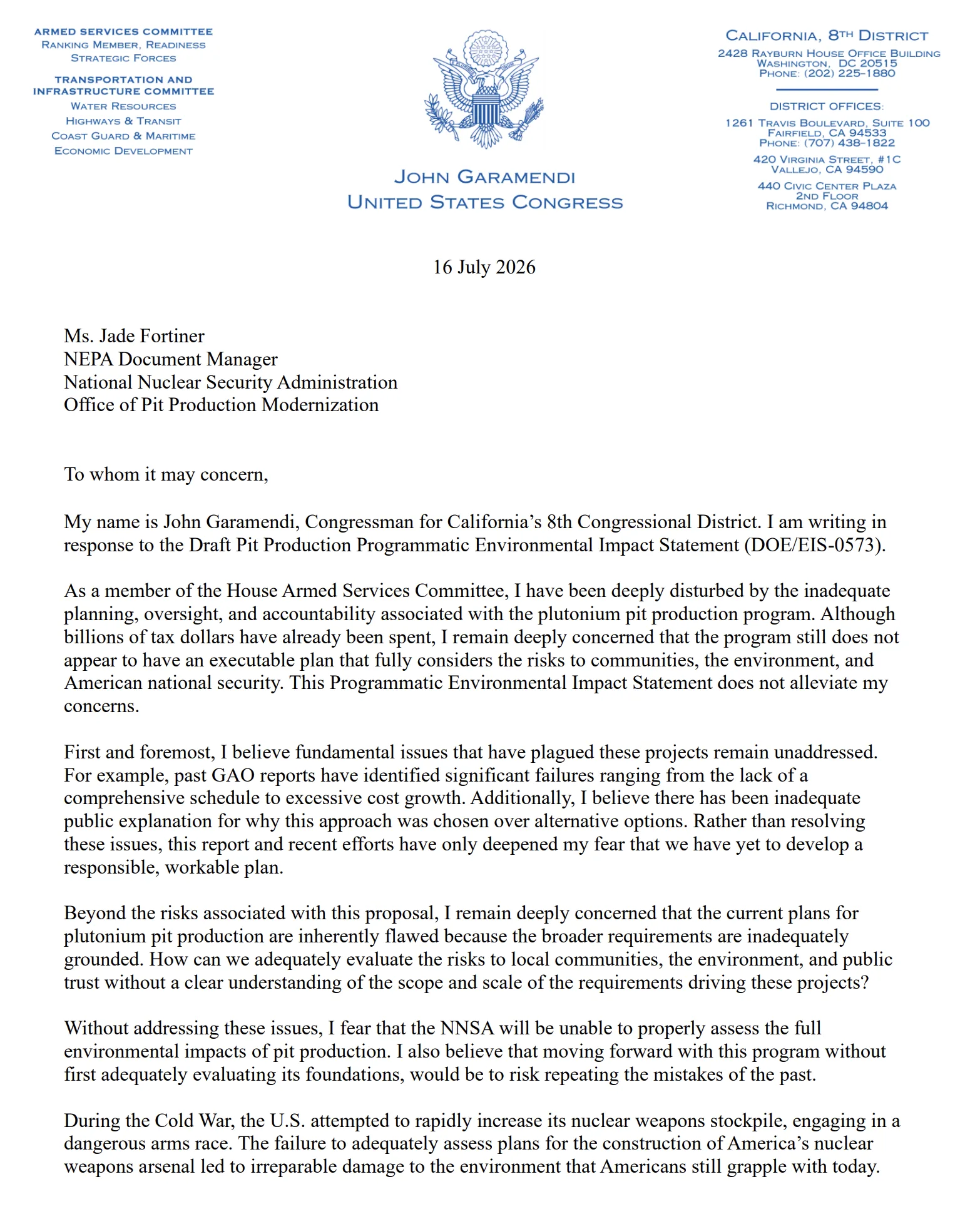
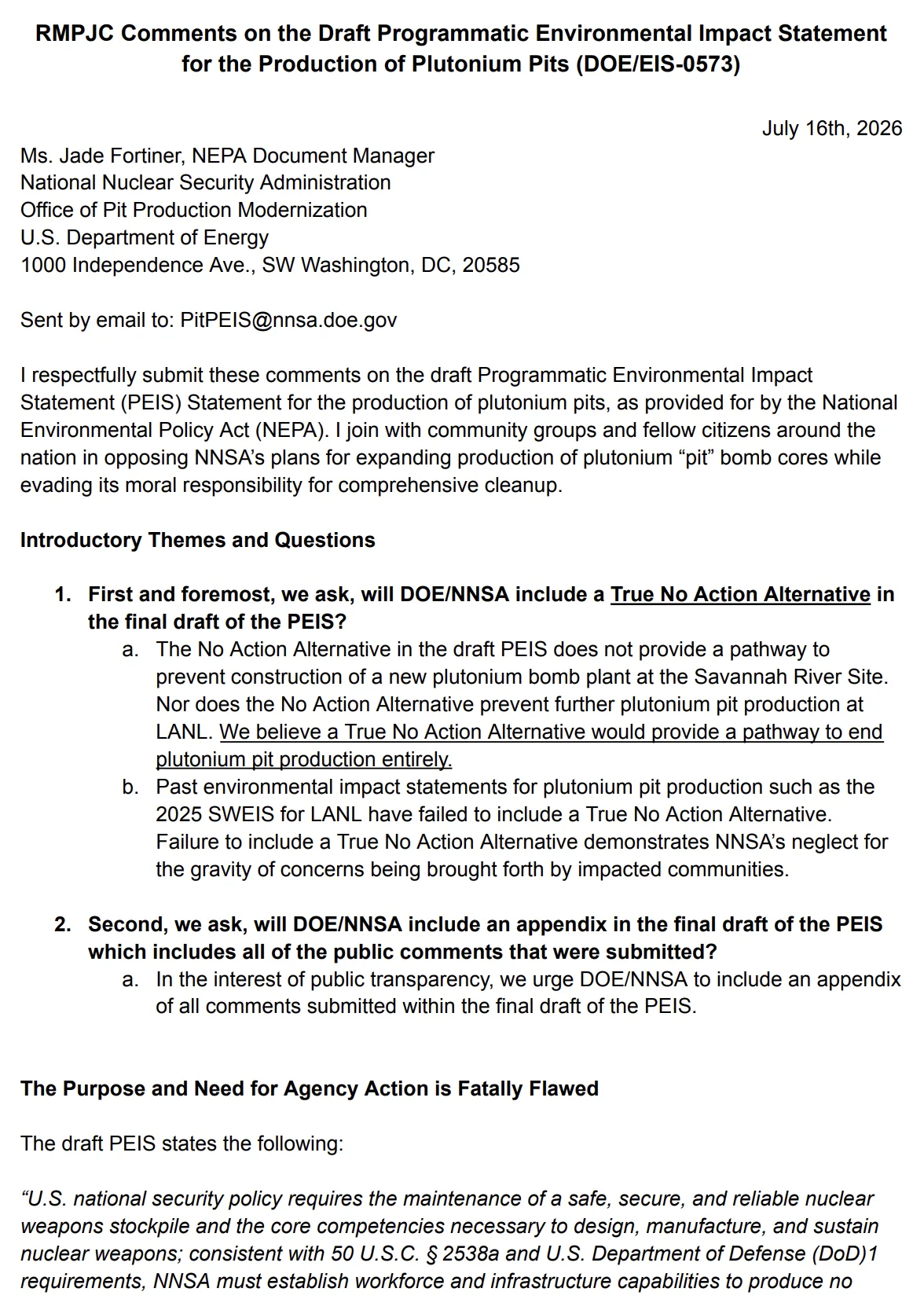
See comments submitted by organizations and individuals below!
In October of 2024, a federal judge in South Carolina found that the United States Department of Energy (DOE) and the National Nuclear Security Administration (NNSA) failed to assess the environmental impact of their plutonium pit expansion plan at South Carolina and New Mexico facilities.
This ruling results in a mandatory review of pit production at DOE sites across the United States, including the management of radioactive waste. Under the National Environmental Policy Act (NEPA), this provides a critical opportunity for public scrutiny of and formal comment on these assessments.
What is a Plutonium Pit?
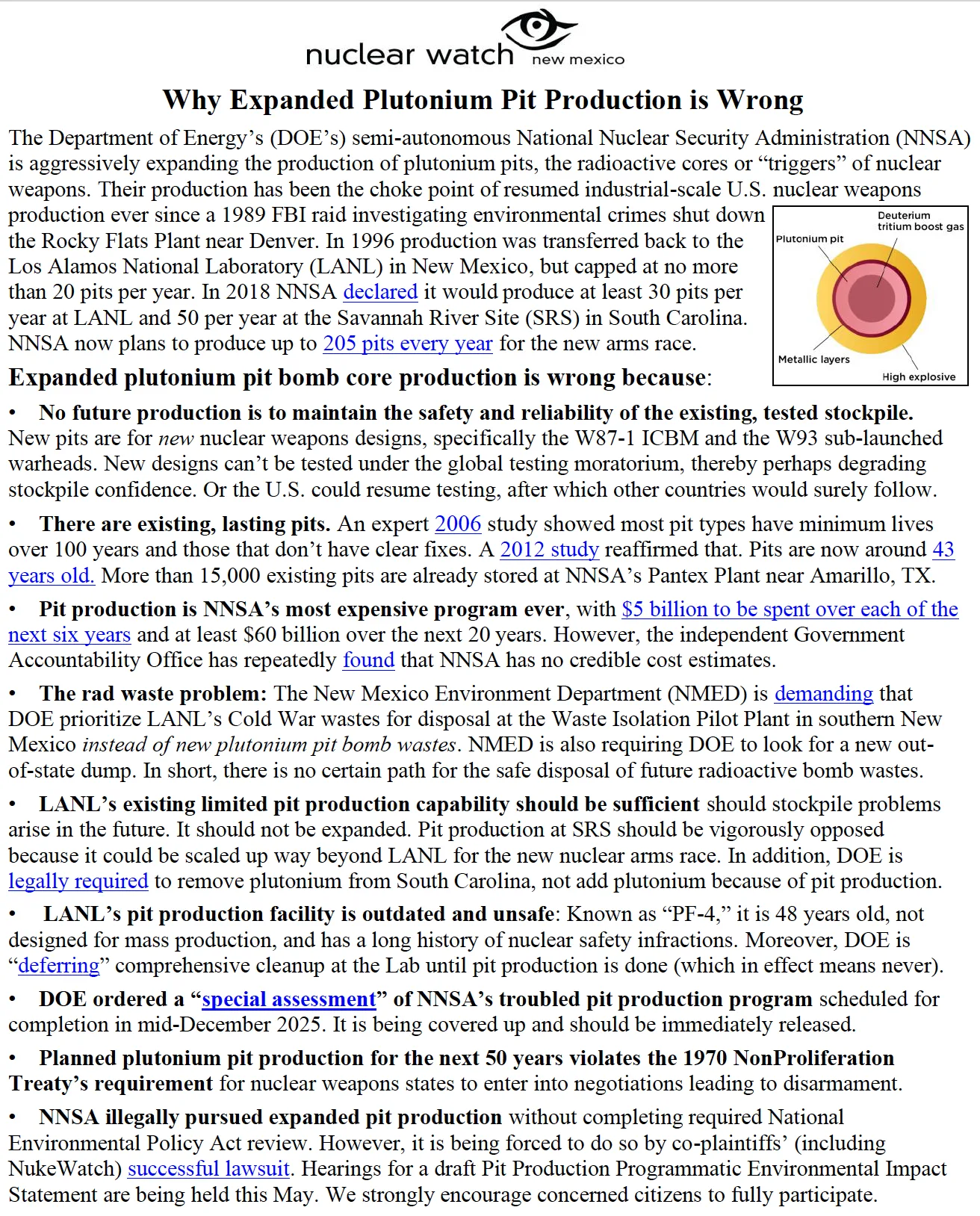
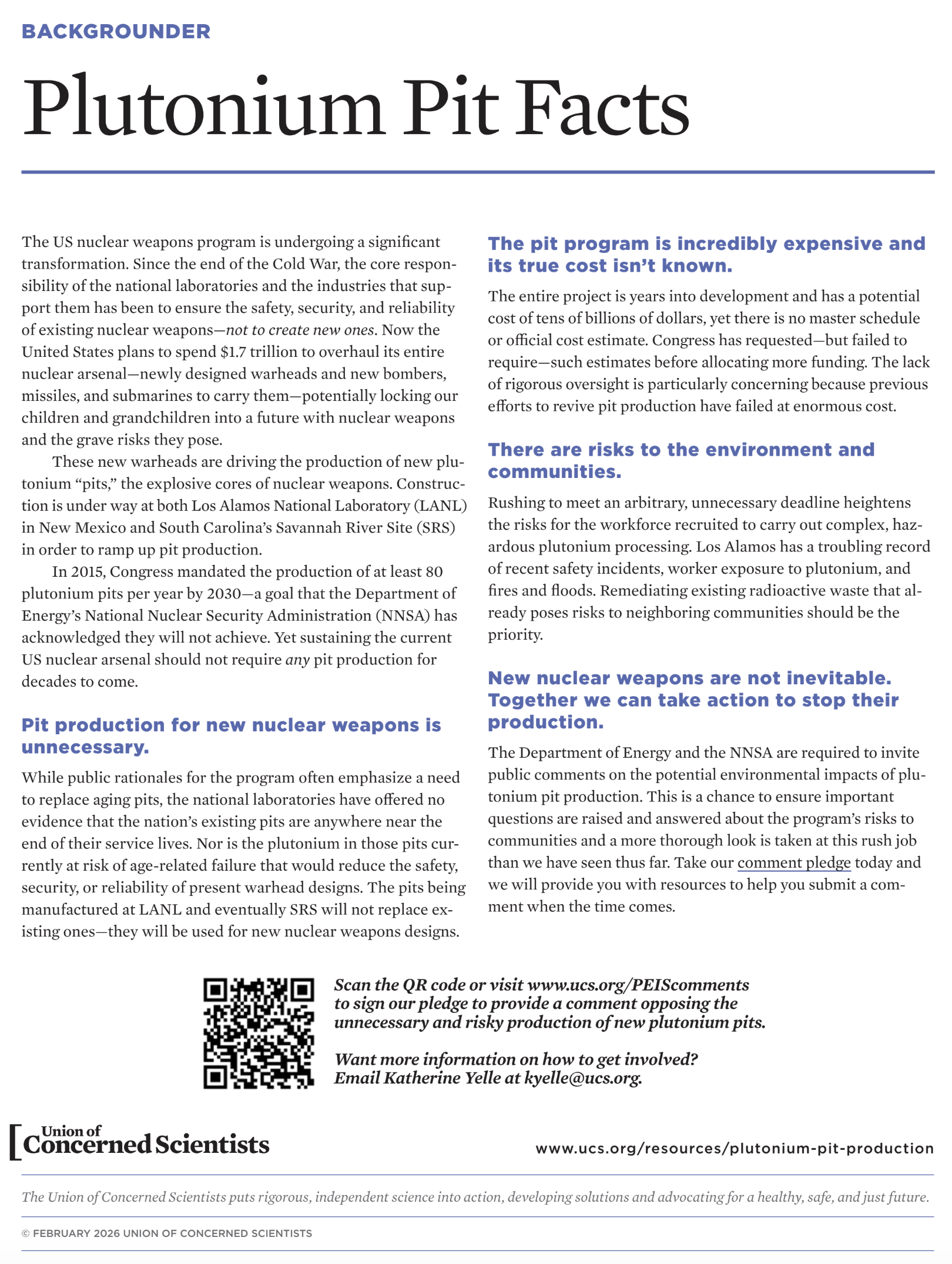
A plutonium pit is the softball-sized bomb core that begins the chain reaction in every modern US thermonuclear weapon. Currently, there is no demonstrated need for new plutonium pits to ensure the safety or reliability of the existing US nuclear weapons stockpile. In fact, these new pits will be for entirely new nuclear weapons. This kind of production involving extremely dangerous radioactive materials puts workers and nearby communities at risk.
History of Pit Production
During the height of the Cold War, the Rocky Flats Plant in Colorado was the nation’s producer of pits , manufacturing 1,000 to 2,000 pits per year between 1952-1989. Major fires occurred at Rocky Flats in 1957 and 1969, both involving plutonium. The site was raided by the FBI and the U.S. Environmental Protection Agency in 1989 for environmental crimes and permanently closed in 1992. The Los Alamos National Lab (LANL) in New Mexico then produced 29-30 pits between 2007-2011 to end the Rocky Flats production run. The US has tried, and failed, several times to revive plutonium pit production — LANL did not produce another pit until October 2024.
In 2018, the federal government ordered the production of at least 80 pits per year by 2030, including at least 30 pits at LANL and at least 50 at the Savannah River Site (SRS) in South Carolina. In 2021, Nuclear Watch New Mexico, Savannah River Site Watch, Tri-Valley Communities Against a Radioactive Environment (CAREs), and the Gullah/Geechee Sea Island Coalition of coastal Georgia sued the National Nuclear Security Administration (NNSA) for failing to consider the full programmatic impacts of plutonium pit production across sites.
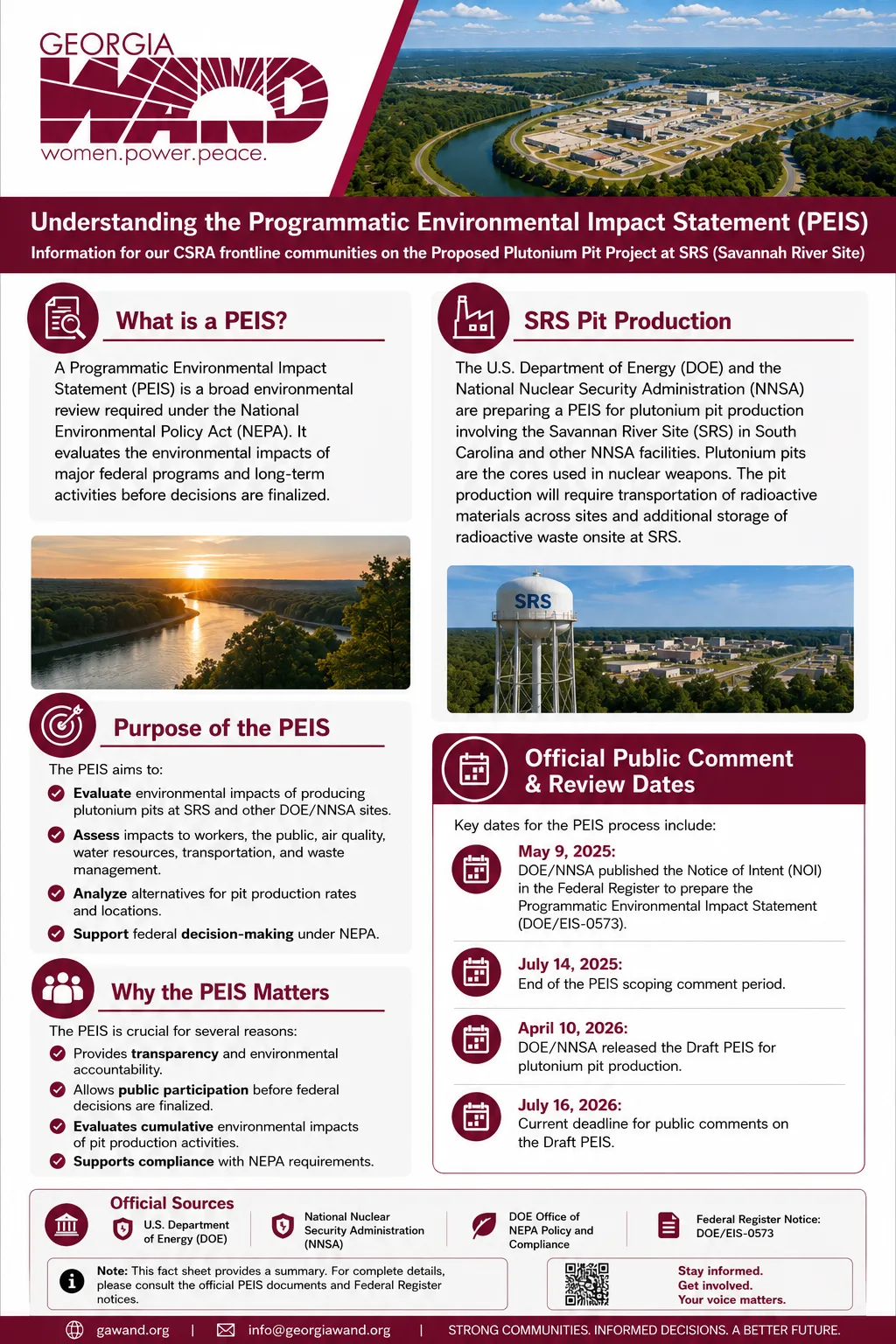
In January 2025, this lawsuit resulted in requiring the NNSA to produce a Programmatic Environmental Impact Statement (PEIS) on plutonium pit production. After scoping hearings in May of 2025, the NNSA released their draft PEIS in April of 2026, kicking off in-person hearings in Livermore, CA, Santa Fe, NM, Aiken, SC, Kansas City, MO, and Washington, DC, as well as a 90-day online public comment period.
Recordings of the PEIS Public Hearings:
Listen to powerful testimony from speakers at the South Carolina, Kansas City MO, Livermore CA, Santa Fe NM, and Washington DC hearings:
North Augusta/Aiken, South Carolina hearing recording:
Kansas City, Missouri hearing recording:
Livermore, California hearing recording:
Santa Fe, New Mexico hearing recording:
Washington, D.C. hearing recording:
Congressional Briefing: Choices Before Congress on Plutonium Pit Production for New Nuclear Warheads, Thursday, June 4, 2026 3-4pm, Senate Russell Office Building, Washington D.C.
Moderated by: Stephen Young – Associate Director of Government Affairs at the Union of Concerned Scientists
Speakers:
Tanvi Kardile – Attorney and Nuclear Policy Program Director at Tri-Valley Communities Against a Radioactive Environment (CAREs) and President of the Alliance for Nuclear Accountability
Jay Coghlan – Executive Director of Nuclear Watch New Mexico
Frank Von Hippel – Emeritus Professor and founding and emeritus codirector of Program on Science and Global Security at Princeton University and the Princeton School of Public and International Affairs
Why should you comment? This process produces valuable information, increases government accountability and transparency, and creates a legal administrative record that has led to important litigation in the past. The Trump administration is severely limiting and removing key opportunities for public comment and objection. Significantly, there is no other legally required opportunity that enables the public to comment on the “modernization” program to keep nuclear weapons forever.
BACKGROUND: The Department of Energy’s (DOE’s) semi-autonomous National Nuclear Security Administration (NNSA) is aggressively expanding the production of plutonium pits, the radioactive cores or “triggers” of nuclear weapons. The Los Alamos National Laboratory (LANL) in New Mexico has been capable of producing plutonium pits since 1996, and until 2018 production was capped at no more than 20 pits per year. NNSA now plans to produce up to 205 pits every year for the new arms race, with at least 80 pits per year made at LANL and at least 125 per year at the Savannah River Site (SRS) in South Carolina.
Grassroots activist organizations Nuclear Watch New Mexico of Santa Fe, NM; Savannah River Site Watch of Columbia, SC; the Gullah/Geechee Sea Island Coalition of coastal Georgia, and Tri-Valley CARES of Livermore, CA successfully sued the NNSA over its failure to complete a required nationwide “programmatic environmental impact statement” (PEIS) for its plan to massively expand plutonium pits production. A draft of this PEIS was released in April 2026, kicking off in-person hearings in Livermore, CA, Santa Fe, NM, Aiken, SC, Kansas City, MO, and Washington, DC, as well as a 90-day public comment period ending July 16, 2026. This provides a unique and critical opportunity for public scrutiny of and formal comment on the government’s plans to make new nuclear bombs for a new arms race!